The Bonus Efficiency Equation: Fixing Negative-ROI Promotions
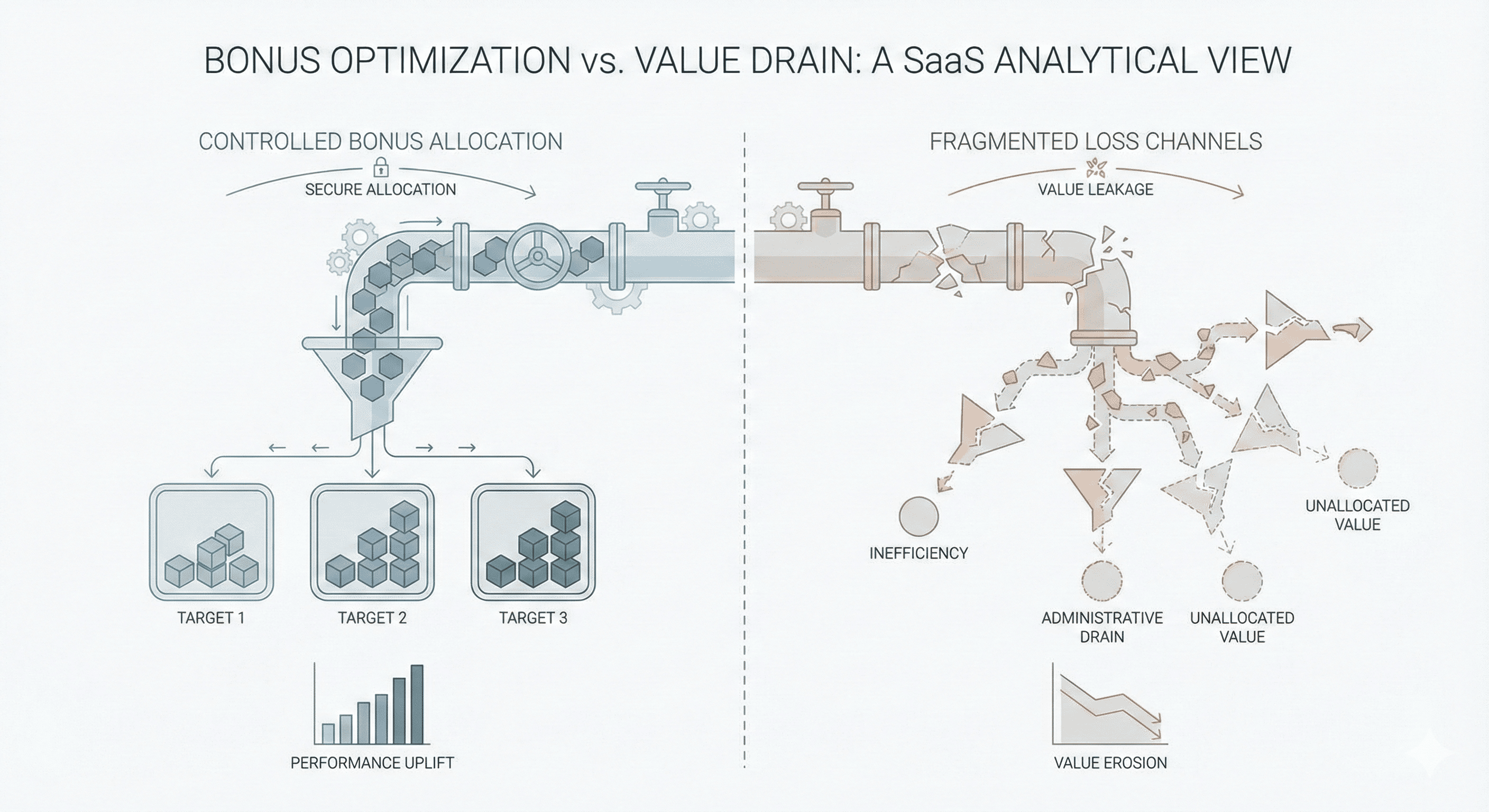
Bonuses are the fastest-growing line item in most iGaming P&Ls—and the least understood. Operators want profitable acquisition and loyal retention; players want value; VIPs want leverage. Somewhere in the middle, bonus budgets quietly drift from strategic asset into silent margin leak. The reason is not lack of data. It is lack of structure.
Few teams share a single, consistent equation for bonus ROI. Different departments use different metrics, different cohorts, and different baselines. Promo cycles inflate short-term KPIs and hide long-term cost patterns. What looks like success often masks redistribution—or outright margin burn.
This article introduces the Bonus Efficiency Equation: a clear, operator-grade framework for measuring, auditing, and fixing negative-ROI bonuses. It does not promise magic. It promises visibility—and visibility is what stops bonus burn.
Operator Pain Point Snapshot
• Bonus costs rising faster than net revenue
• Promotions optimized for volume, not efficiency
• VIPs exploiting repeatable bonus loops
• No unified way to calculate true bonus ROI
• Teams disagree on what success even looks like
• Legacy systems cannot surface cohort-level ROI transparently
Why Bonus ROI Matters More Than Ever
Bonuses have shifted from tactical offers to a core part of operator economics. Yet bonus governance remains inconsistent. Finance sees cost. CRM sees engagement. Marketing sees acquisition. VIP sees bargaining chips. Compliance sees risk.
Bonuses impact every profitability driver simultaneously. Abuse patterns evolve faster than governance models. Promo-heavy cycles distort LTV signals if not normalized. This is why a consistent ROI framework is mandatory—not optional.
The Bonus Efficiency Equation (Standard Framework)
At its simplest, bonus efficiency is defined as:
Bonus Efficiency = (Bonus-Attributable Revenue − Bonus Cost) / Bonus Cost
This simplified formula is intuitive but incomplete. It hides indirect costs, abuse leakage, and cohort baseline distortions that dominate real-world operator economics.
Expanded operator-grade standard equation:
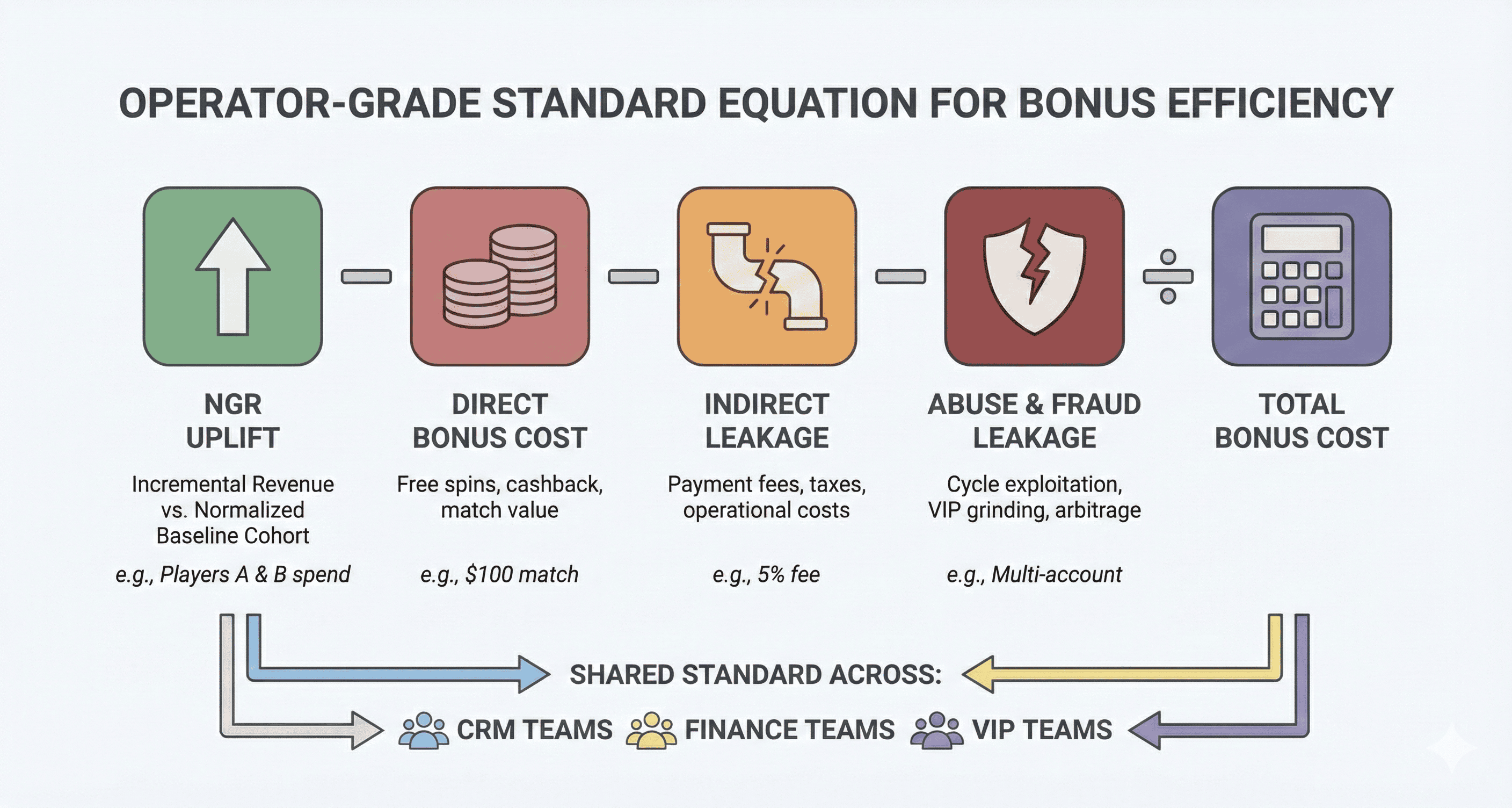
Bonus Efficiency = (Net Gaming Revenue uplift from bonus cohort − Direct bonus cost − Indirect cost leakage − Abuse and fraud leakage) / Total bonus cost
• NGR uplift measures incremental revenue versus a normalized baseline cohort
• Direct bonus cost includes free spins, cashback, and match value
• Indirect leakage includes payment fees, taxes, and operational costs
• Abuse includes cycle exploitation, VIP grinding, and cross-brand arbitrage
This equation should act as a shared standard across CRM, Finance, and VIP teams.
The Five Structural Patterns Behind Negative-ROI Bonuses
[IMAGE PLACEHOLDER: negative_roi_bonus_patterns.png]
Negative ROI rarely appears randomly. In practice, it clusters into a small number of repeatable structural patterns.
1. Deposit Match Saturation
Repeated triggering without incremental NGR uplift, leading to flat revenue curves.
2. Forever Reload Mechanics
Reload bonuses without caps that allow long-term value extraction.
3. Uncapped Cashback Offers
Guaranteed negative expected value during high-loss days.
4. High-Variance Free Spins
Volatility overwhelms expected value assumptions, creating asymmetric exposure.
5. VIP Grinding Loops
High-value players extracting bonuses systematically across brands.
In practice, the majority of structural bonus losses come from uncapped reloads and VIP grinding loops.
How to Measure True Bonus Uplift
Short-term spikes in turnover, sessions, or deposits are not uplift.
True uplift must be baseline-adjusted and cohort-normalized.
NGR uplift = NGR (bonus cohort) − NGR (baseline cohort)
If baseline performance is not normalized, any bonus ROI calculation is misleading.
The Cohort ROI Matrix for Bonus Governance
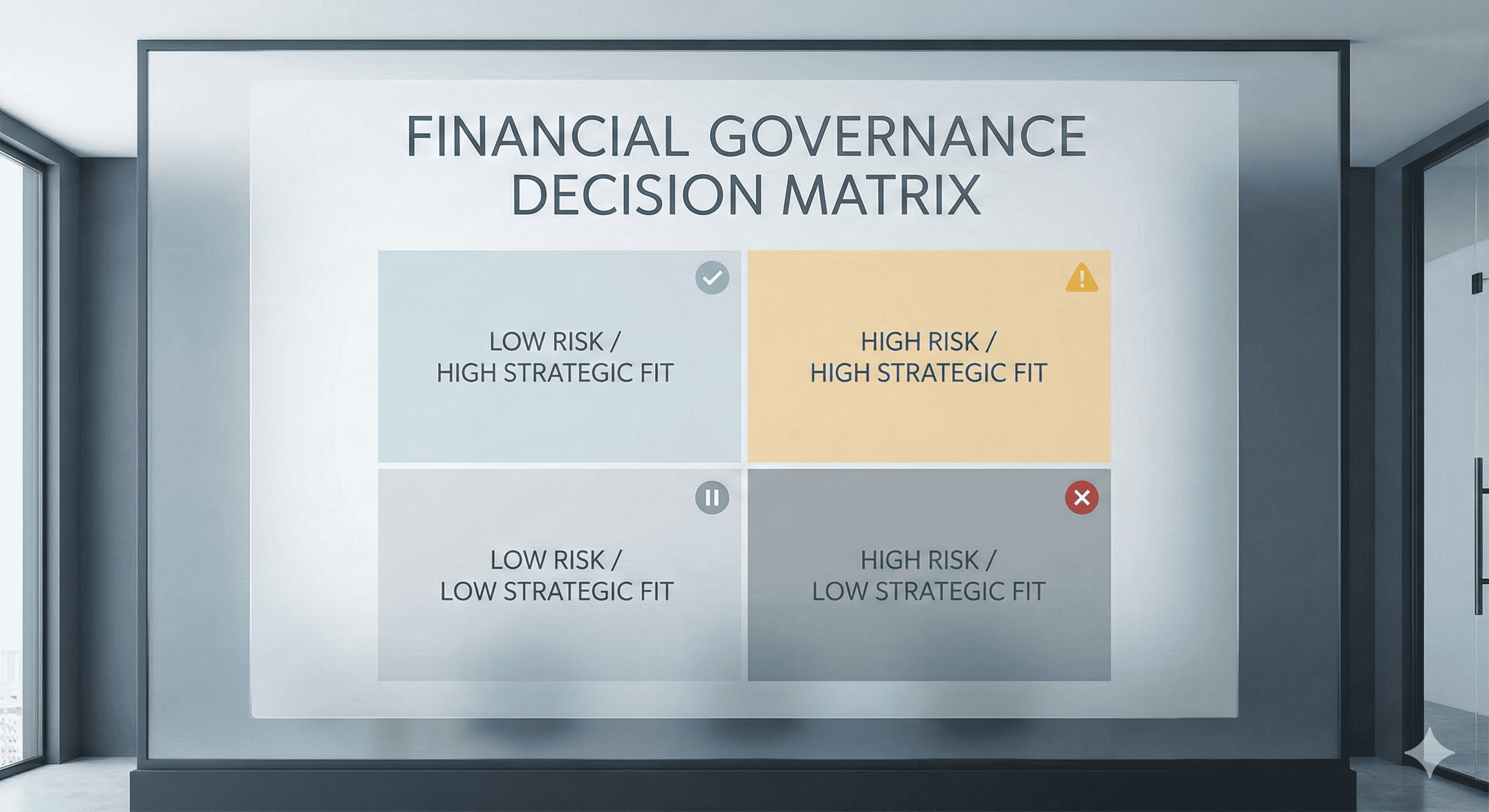
The cohort ROI matrix maps bonus cost against incremental NGR uplift. It transforms bonus analysis from reporting into governance.
Most negative-ROI bonuses sit in the medium-to-high cost, medium uplift zone—appearing successful operationally while eroding margin structurally.
Detecting Bonus Abuse and Leakage
Bonus abuse is predictable and cumulative. Even small leakage rates compound into material margin loss at scale.
Abuse and indirect leakage must be explicitly subtracted from any ROI calculation to avoid systematic overestimation.
Operationalising the Bonus Efficiency Equation

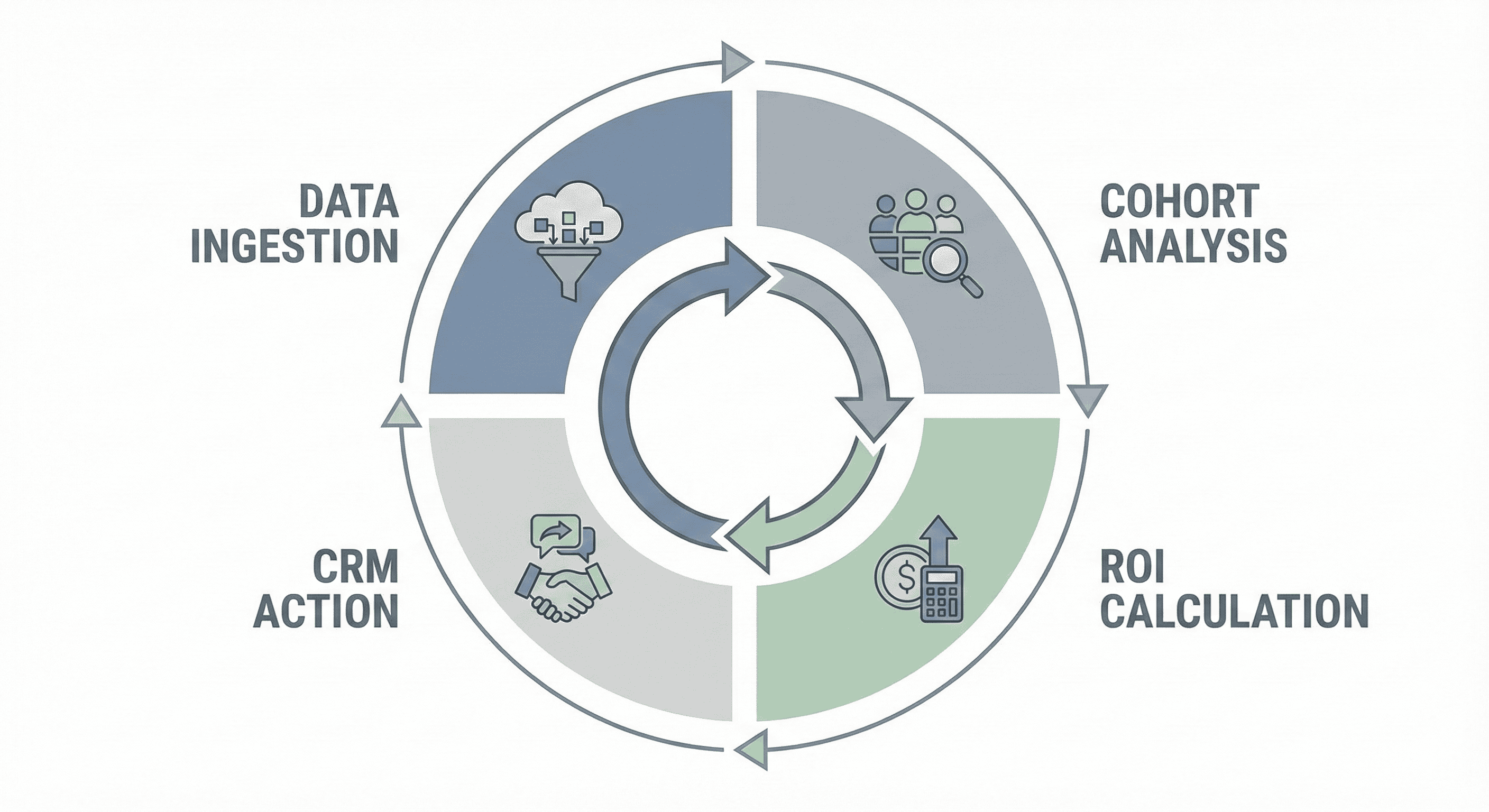
A formula alone is insufficient. Bonus efficiency must operate as a closed system linking data ingestion, cohort analysis, ROI calculation, and CRM action.
Operator Playbook: Five Steps to Bonus Efficiency
1. Establish a 90-day normalized baseline
2. Audit all active bonuses for negative-ROI patterns
3. Align CRM, Finance, and VIP teams on one ROI equation
4. Segment promotions by ROI contribution
5. Introduce caps, diminishing returns, and real-time guardrails
Glossary
Bonus Efficiency — Ratio of bonus-driven uplift versus total cost
Bonus Leakage — Margin loss from abuse, fraud, or indirect costs
Cohort Normalization — Adjusting baseline behaviour to isolate uplift
Deposit Match Saturation — Repeated triggering without revenue growth
VIP Grinding — Systematic bonus extraction across brands
NGR Uplift — Incremental net gaming revenue attributable to bonuses
Variance Cost — Exposure created by volatile bonus-linked mechanics
Baseline Drift — Natural behavioural change unrelated to promotions
Frequently Asked Questions
What is the Bonus Efficiency Equation?
It is a standardized operator framework combining uplift, direct cost, indirect leakage, and abuse into a single ROI value.
Why do bonuses generate negative ROI?
Because bonus cost scales predictably while incremental uplift does not—especially under saturation and VIP arbitrage.
How should operators calculate bonus uplift?
By comparing matched cohorts before and after promotions, normalized for seasonality and overlapping campaigns.
What counts as bonus leakage?
Fraud, systematic abuse, cross-brand rotation, chargebacks, tax, and indirect operational costs.
How can bonus ROI be improved quickly?
Introduce caps, diminishing reload mechanics, variance filters, and a unified cross-team ROI standard.
Conclusion: Bonus Efficiency Is an Operating Standard
Bonuses are not the problem. Lack of visibility is.
The Bonus Efficiency Equation provides a shared lens for evaluating promotions through uplift, leakage, and cohort reality.
If you cannot calculate this equation today, you are already subsidising someone else’s margin.
Next Steps
• Download the Bonus Efficiency Calculator
• Book a Bonus ROI Audit (45 minutes)
• Explore HumanGraph’s Bonus Intelligence Module
